Thin nylon bracket at large deflection: where linear FEA overshoots by 29%
“Our thin nylon bracket visibly bends under its working load — can we still trust linear FEA numbers, and does the part actually hold?”
The ask
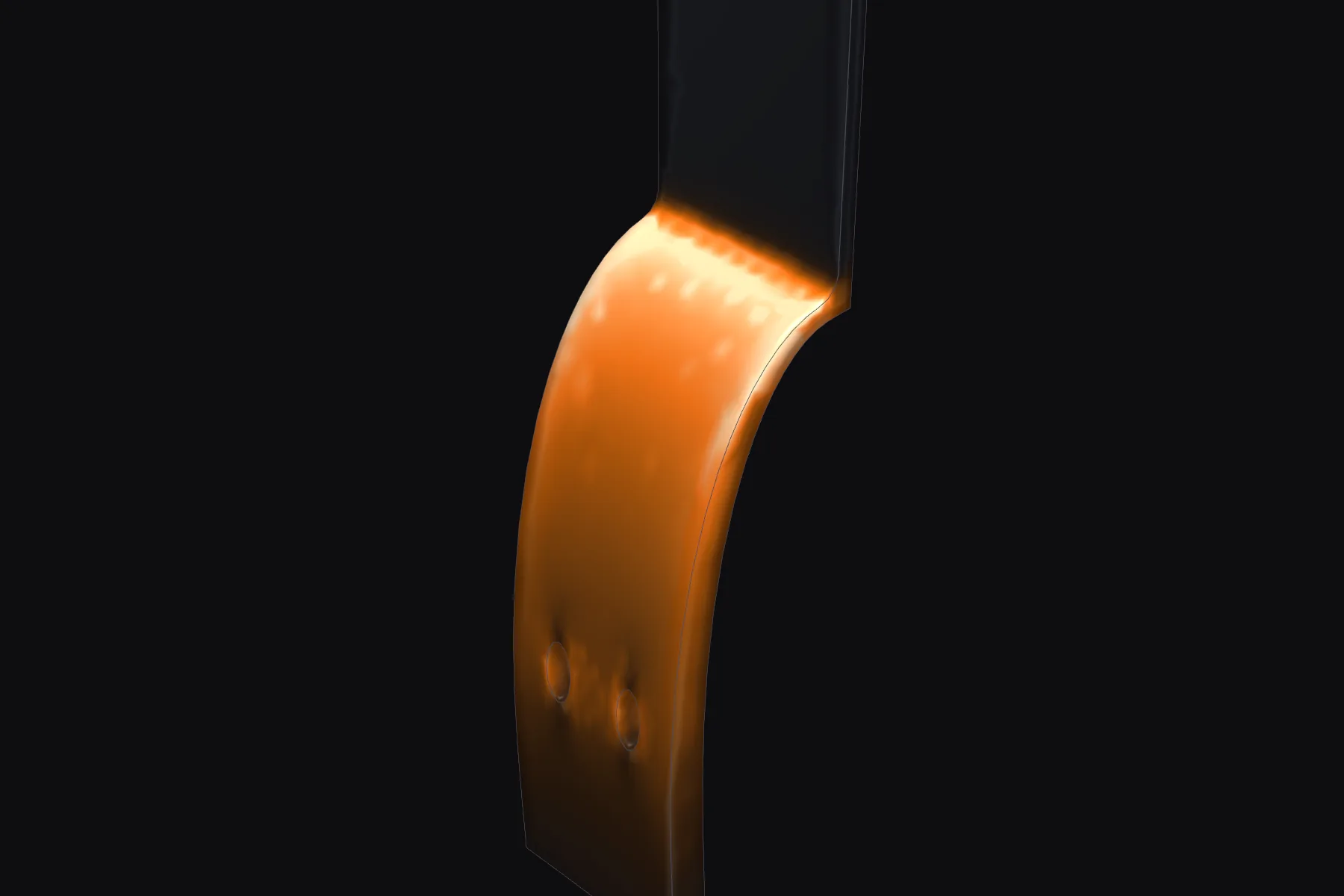
NOTE ON THE SITE CAPTION: the glowing render from this run is sometimes labeled a "plastic hinge." That overstates the physics. This analysis modeled geometric nonlinearity only — a finite-strain compressible neo-Hookean (hyperelastic) solve; no plasticity model was active in config.yaml or the report. The glowing band is a von Mises stress concentration at the fillet root. Since the reported safety factor on yield is 0.60, real PA6 would in fact yield there — behavior this run deliberately did not simulate. The caption should say "large-deflection stress concentration at the fillet," not "plastic hinge." — The job itself: a thin (5 mm) nylon PA6 variant of the demo bracket, 120 mm characteristic size, carrying 360 N straight down on its tagged load pad. Predicted deflection is a large fraction of the part size — squarely in the regime where linear small-displacement theory drifts. The ask: solve the finite-strain problem, run the linear model alongside it as a reference, and report how far linear theory is off and whether the part survives.
What the pipeline ran
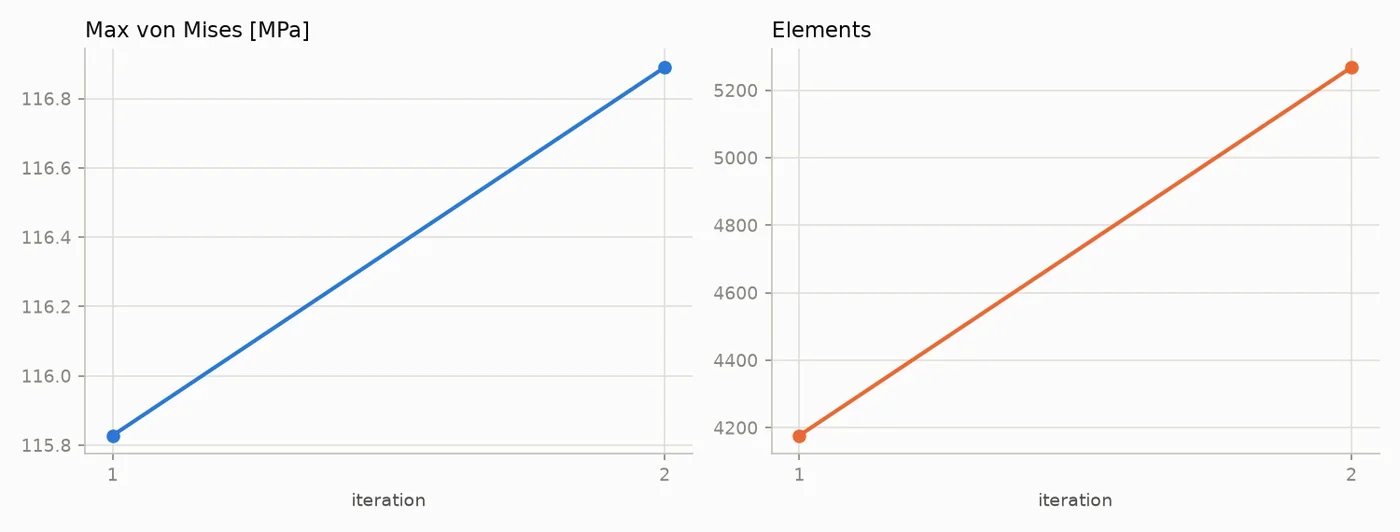
Smidr's native finite-strain solver: total Lagrangian compressible neo-Hookean, incremental Newton over 8 load steps with automatic step cutting (up to 4 cuts, tolerance 1e-6), dead loads, and a linear reference solved for comparison. Geometry and meshing via Gmsh/OpenCASCADE with quadratic (P2) tetrahedra; 1.5 mm pilot holes were defeatured below the 4 mm threshold while the 6 mm fillet and 9 mm bolt holes were modelled. The adaptive agent ran 2 mesh iterations — 4,177 elements then a targeted refinement of the high-stress band to 4.5 mm elements, ending at 5,268 elements / 30,306 DOFs — and accepted on a 0.92% peak-stress delta against a 3% tolerance. Total wall time 3,692 s (about 62 minutes).
The verdict
- Pipeline's own reason: newton_health — 1 load increment needed cutting; the solution path is near a nonlinearity, results at final load are converged but margins are thin.
- Reported safety factor on yield is 0.60 (116.9 MPa peak von Mises vs 70 MPa PA6 yield): the deflection answer stands, but the part fails the strength check as designed — and this run's material model does not include plasticity, so post-yield behavior was not simulated.
Key numbers
| Metric | Value | Note |
|---|---|---|
| Applied load | 360 N | Vertical traction on the tagged load pad; 100% of load carried to convergence |
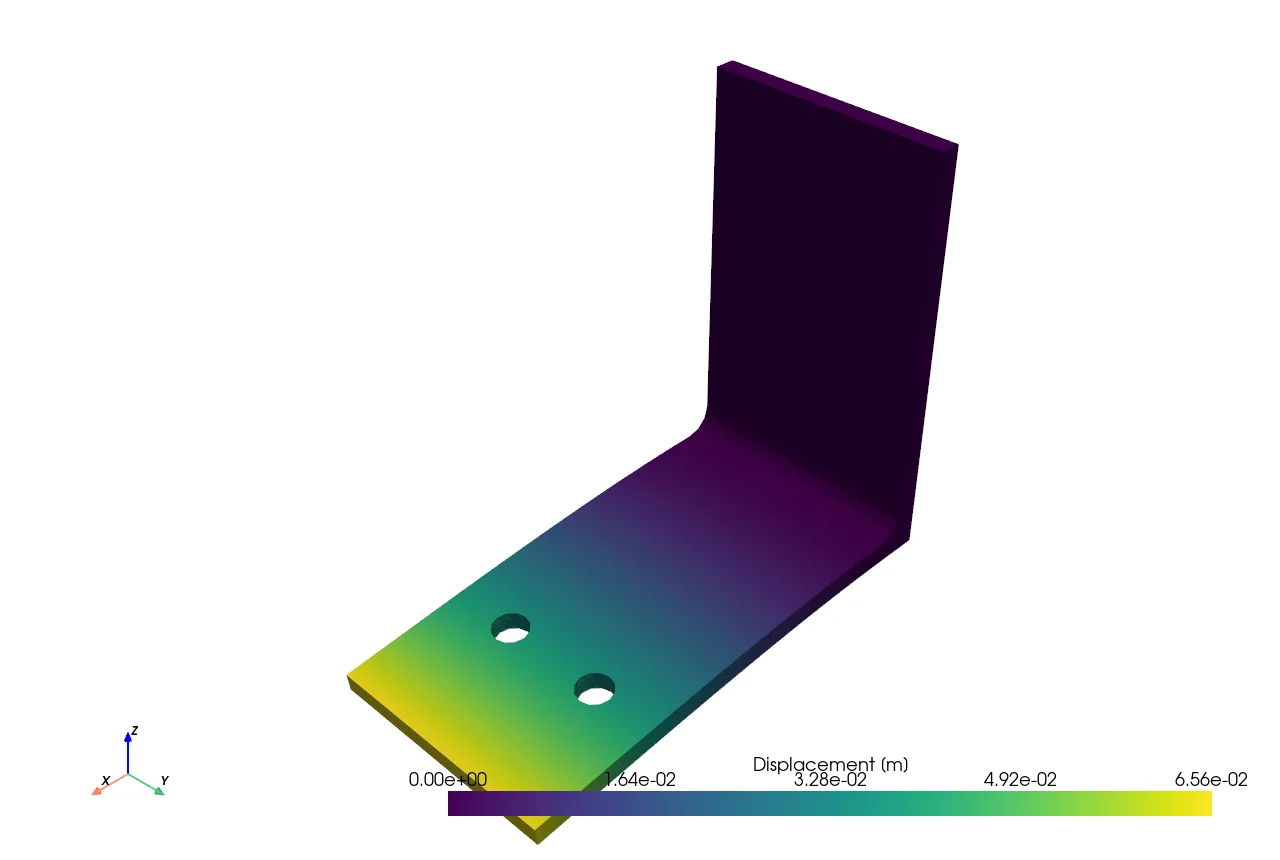
| Max deflection (nonlinear) | 65.6 mm | Finite-strain result at full load, on a 120 mm part |
| Max deflection (linear theory) | 92.7 mm | Linear model overpredicts by 29.3% — the reason this run exists |
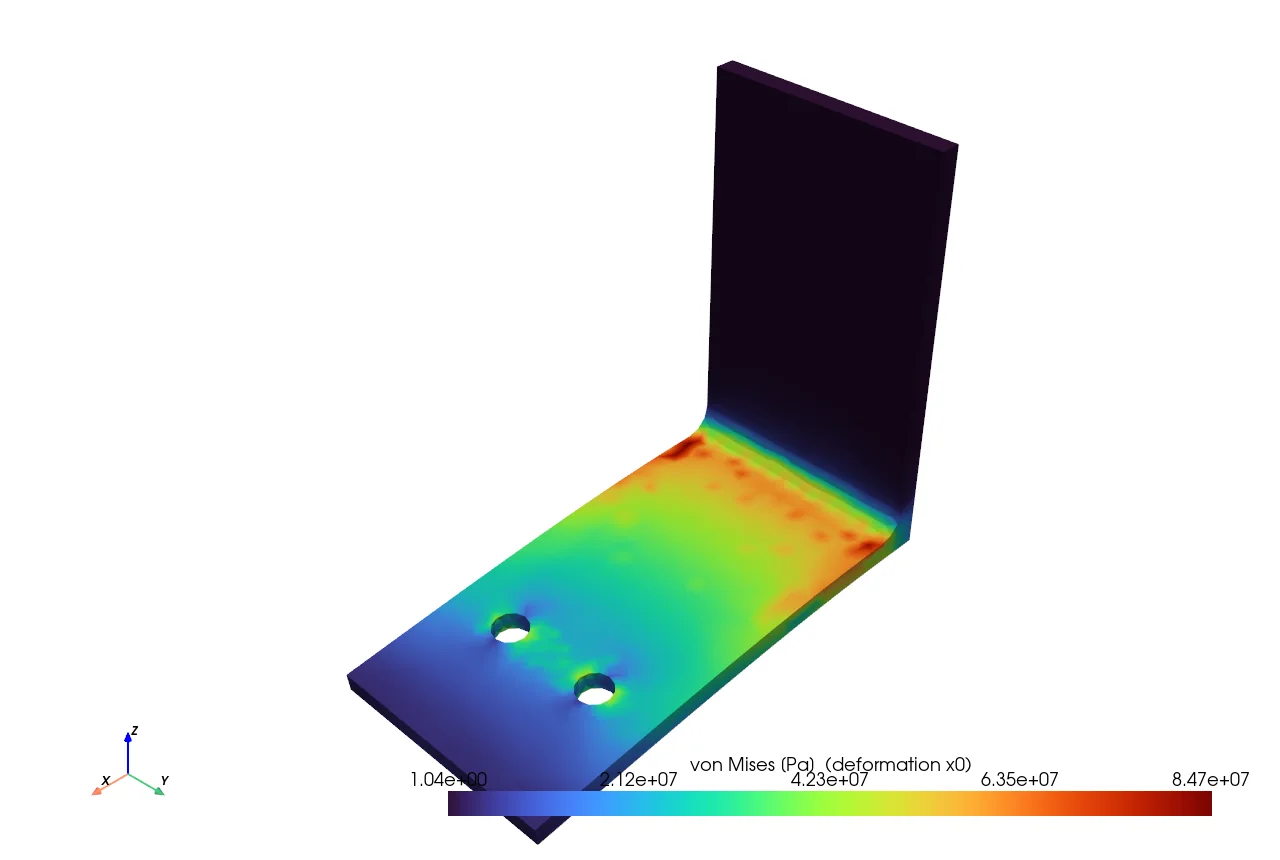
| Peak von Mises stress | 116.9 MPa | At the fillet root, final mesh |
| Safety factor on yield | 0.60 | vs 70 MPa yield for PA6 dry — part exceeds yield; no plasticity modeled |
| Mesh-convergence delta | 0.92% stress / 0.16% deflection | Between adaptive iterations 1 and 2; acceptance tolerance 3% |
| Final mesh | 5,268 P2 tets / 30,306 DOFs | Min element quality SICN 0.306, 0% of elements below 0.2 |
| Newton robustness | 1 step cut at 37.5% load | Auto-recovered with a halved increment; every accepted step converged to residual below 1e-6 |
| Wall time | 62 min | Full adaptive run: 2 mesh passes, 15 accepted load increments each |
Quality, stated plainly
The run converged and says so with numbers: two adaptive mesh passes, with peak von Mises moving 0.92% and max deflection 0.16% between them against a 3% tolerance, on a final mesh with minimum element quality SICN 0.306 and zero elements below the 0.2 floor. Every accepted Newton increment closed to a residual below 1e-6. The pipeline did not hide the rough spot: in both mesh passes the Newton solver stagnated at the 37.5% load increment and recovered by cutting the step — that WARN was carried straight into the verdict, downgrading the run to CONDITIONAL instead of green, because the solution path sits near a nonlinearity and margins are thin. Two more caveats stay on the record: the material model is hyperelastic with no plasticity, so the 116.9 MPa peak (above PA6's 70 MPa yield) is a flag, not a prediction of post-yield behavior; and no CalculiX cross-check deck exists for this run — the deck export covers linear static only, so the large-deflection solve stands on the native solver alone.
Figures from the run
Why this matters
If you had run this bracket through ordinary linear FEA, you would have designed around a 92.7 mm deflection. The real answer is 65.6 mm — linear theory is off by 29.3%, enough to fail a fit check or falsely fail a stiffness spec. That is the case for paying for a nonlinear solve when deflections get large. But the more important thing this case study shows is what the pipeline does when the news is bad: it reported a safety factor of 0.60, kept the solver's own warning about thin convergence margins visible, and returned CONDITIONAL rather than a reassuring green. You get the number, the confidence in the number, and the limits of the model — which is exactly what you need to decide whether to redesign the part or commission the plasticity study this result says you need.
- Geometric nonlinearity only: neo-Hookean hyperelastic material, no plasticity — the 116.9 MPa peak exceeds PA6's 70 MPa yield, so real post-yield stress redistribution is not captured.
- Newton solver cut one load increment at 37.5% load in both mesh passes; converged at full load, but margins are thin — this is the basis of the CONDITIONAL verdict.
- 1.5 mm pilot holes were defeatured (below the 4 mm threshold); stress local to those holes is unresolved.
- Material properties are 'Nylon PA6 dry (typical)' handbook values — no moisture conditioning, rate, or creep effects.
- No independent cross-check for this run: CalculiX deck export covers linear static only, so the large-deflection solve runs natively without a second-solver comparison.
Your part. Your question. Same rigor.
Send us the geometry and the question — get the analysis, the honest error bars, and a verdict you can defend.
Request pilot access