Seismic response spectrum on a loaded server rack: the run that refused to sign off
“Will our fully loaded server rack ride out a zone-4-level earthquake without yielding — and can we sign off on it?”
The ask
A steel server rack — four S355 posts, four shelves, 80 kg of payload per shelf, 616.4 kg all in — has to survive a seismic event. The job: run a modal response-spectrum analysis against a zone-4-style 5%-damped design spectrum in the lateral direction, extract 10 modes, combine by SRSS, and answer three questions a reviewer will ask: what is the base shear, does the frame stay below yield with margin, and which modes actually carry the load.
What the pipeline ran
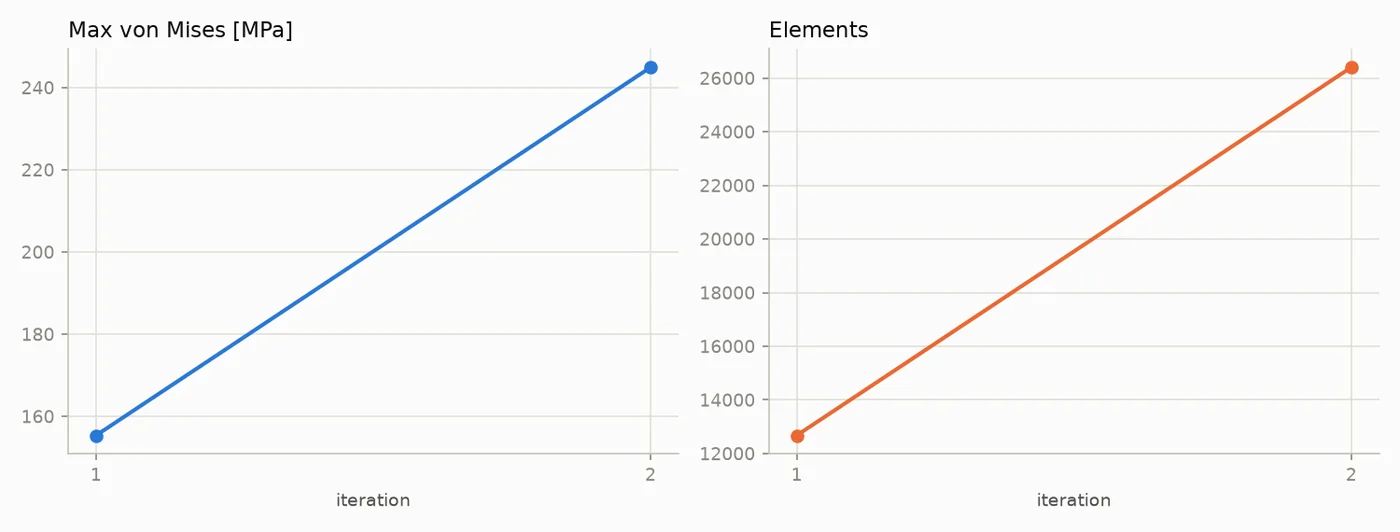
Smidr's adaptive agent built the geometry and mesh in Gmsh/OpenCASCADE (quadratic tets, payload smeared into the shelf volumes), ran a consistent-mass eigensolve for 10 modes, applied per-mode spectral accelerations from the design spectrum, and SRSS-combined stresses and displacements. It completed 2 adaptive iterations — 12,673 elements on the first pass, then local refinement to 25 mm in the high-stress band for 26,404 elements and 153,996 DOF on the second — in 68 seconds of wall time end to end, including both solves and the auto-generated report.
The verdict
- Safety factor 1.45 vs. yield — below the 1.5 target, and the mesh trend says the converged value is lower
- Only 89.5% of X-direction effective mass captured (target >= 90%) — SRSS demand is underestimated; more modes needed
- Not mesh-converged: peak von Mises changed +57.7% between mesh iterations against a 3% tolerance
Key numbers
| Metric | Value | Note |
|---|---|---|
| Verdict | CONDITIONAL | Three independent checks flagged; results usable for scoping, not sign-off |
| Dominant lateral mode | 5.26 Hz | Mode 2, sitting on the spectrum's 1.0 g plateau, carrying 73.5% of effective mass |
| SRSS base shear | 4.47 kN | About 0.74x the rack's own weight (~6.05 kN) — the anchorage number a reviewer asks for first |
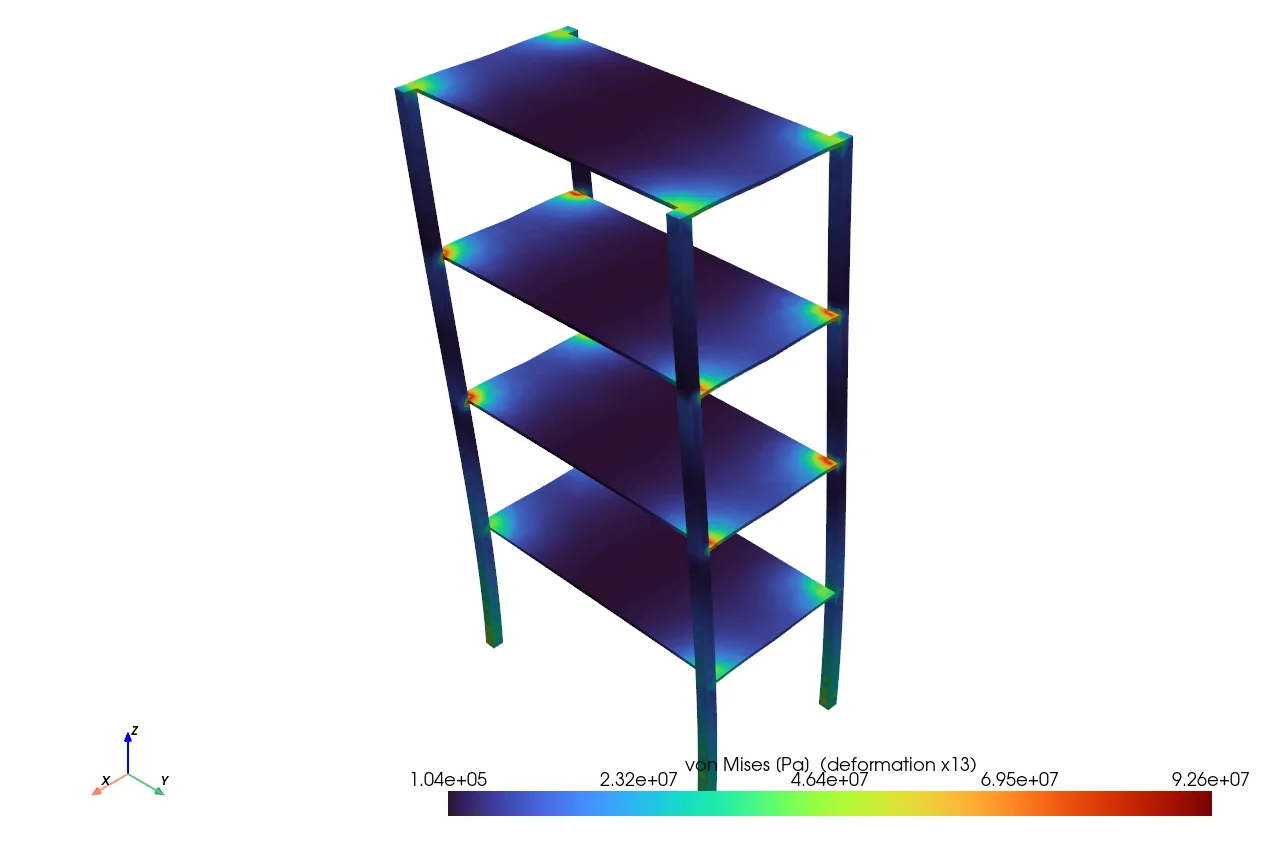
| Peak SRSS von Mises stress | 244.9 MPa | NOT mesh-converged: +57.7% vs. the coarse mesh, still climbing |
| Safety factor vs. yield (355 MPa) | 1.45 | Below the 1.5 target — and an optimistic upper bound given the unconverged stress |
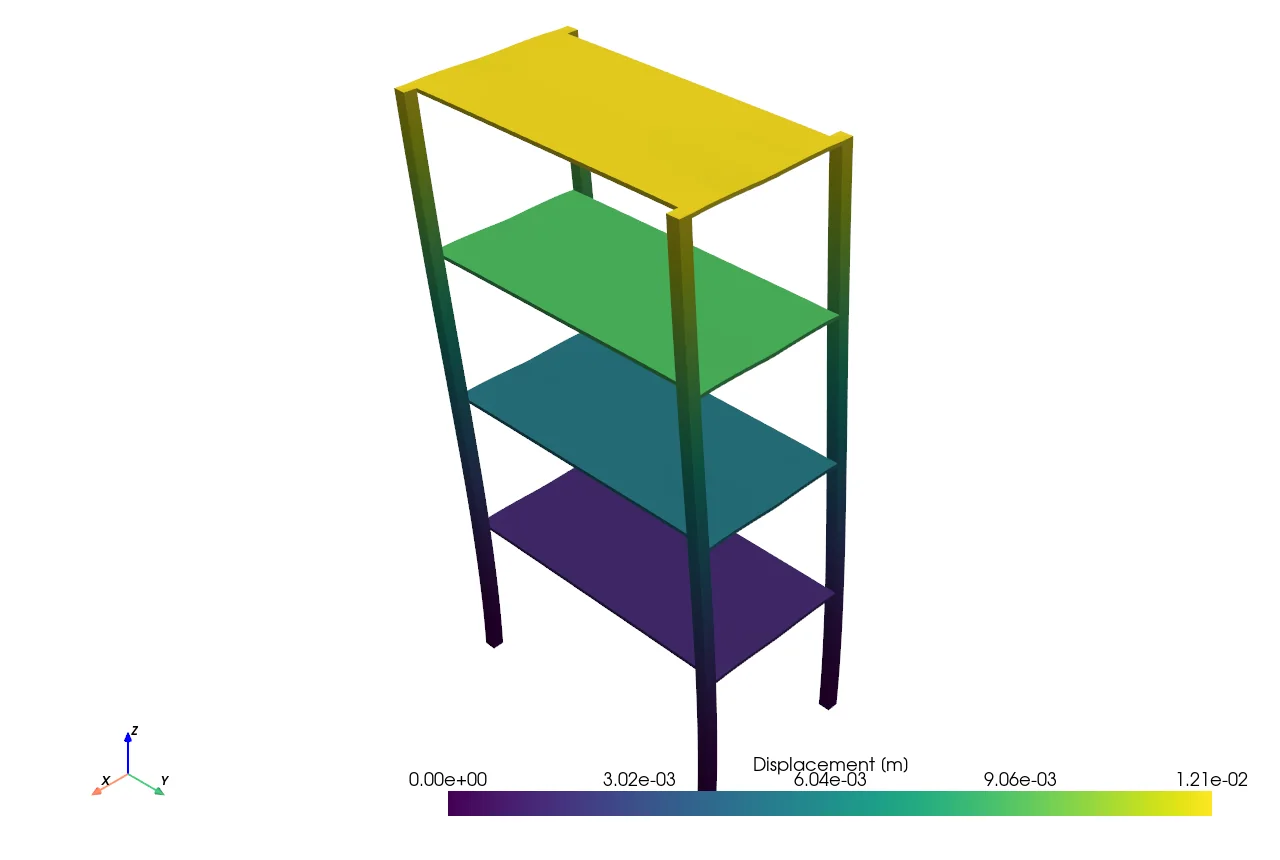
| Peak lateral deflection | 12.1 mm | Only +6.0% between meshes — far more trustworthy than the local stress |
| Captured effective mass (X) | 89.5% | Under the 90% target, so SRSS demand is slightly underestimated |
| Final mesh | 26,404 elements / 153,996 DOF | Quadratic tets; mesh quality passed (min SICN 0.252, 0% below 0.2) |
| Wall time | 68 s | Two adaptive mesh iterations, modal solves, checks, and report included |
Quality, stated plainly
This run is on the site because of what it refused to say. Between the two mesh iterations, peak von Mises jumped from 155.4 to 244.9 MPa — a 57.7% change against a 3% convergence tolerance — dropping the safety factor from 2.29 to 1.45 with the trend still heading down. The agent hit its 2-iteration budget, and instead of quietly reporting the last number, it stopped and said so: verdict CONDITIONAL, stress flagged as non-conservative and unfit for sign-off, with a note that the hotspot sits at a mid-height shelf-to-post junction (not the fixed base, so it is not a boundary-condition artifact — but a sharp re-entrant corner cannot be ruled out as the driver). The same report separates what it does trust: mode 2 shifted only -2.9% between meshes and both dominant modes sit on the spectrum plateau, so the frequencies, base shear, and deflection are solid; and it flags that 89.5% of lateral effective mass captured falls just short of the 90% bar. Mesh quality passed on both iterations. The report's own recommendation: refine further, extract more modes, and expect the converged safety factor to land below 1.45.
Figures from the run
Why this matters
Any FEA service can hand you a stress contour and a safety factor. The question is whether it tells you when that number is not ready. Here the pipeline produced SF 1.45 — a number that looks perfectly plausible on a slide — and then flagged it as an unconverged upper bound, listed exactly why, told you which results you could rely on instead (frequencies, base shear, deflection), and prescribed the path to a defensible answer. That is the check you want running before a rack full of your hardware meets a real earthquake: an engine whose failure mode is "here is what I do not yet know," not a confident wrong answer.
- The spectrum is a generic zone-4-style placeholder — the project/site 5%-damped spectrum must be substituted before any sign-off.
- Gravity is excluded (spectrum-only run); results must be combined with the static gravity case at the code-check level, and SRSS envelopes are sign-less, so component-wise superposition needs care.
- Single-direction (X) excitation only — no orthogonal or vertical components and no directional combination rule (e.g. 100/30) applied.
- Linear elastic with rigid connections and smeared payload: no bolt/anchor, weld, overturning, or shelf-attachment checks are included.
- No independent CalculiX cross-check for this analysis type (deck export covers linear static only), and the hotspot must be distinguished from a sharp re-entrant-corner singularity before the peak stress is used.
Your part. Your question. Same rigor.
Send us the geometry and the question — get the analysis, the honest error bars, and a verdict you can defend.
Request pilot access